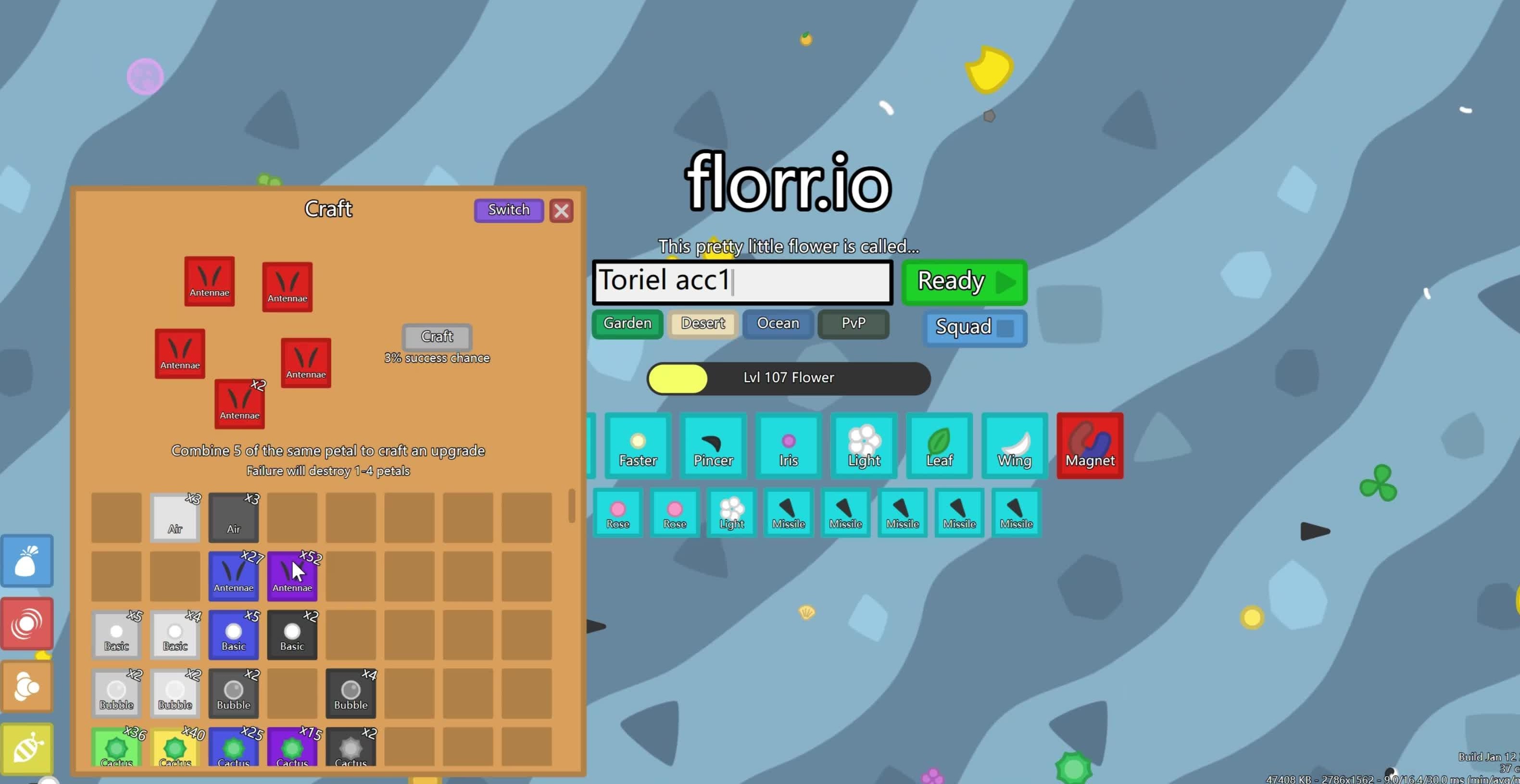
Florr.io Crafting Guide
This guide shows success rates, expected material costs, special forges, and when to craft rather than farm or buy.
Basic crafting rules
In the crafting menu you combine five identical petals of the same type and rarity, which gives you a chance at getting the higher rarity copy. On failure you lose 1-4 of the inputted petals; you need at least five of a given rarity and type to attempt to craft.
Tier success rates
- Common to Unusual: 64%
- Unusual to Rare: 32%
- Rare to Epic: 16%
- Epic to Legendary: 8%
- Legendary to Mythic: 4%
- Mythic to Ultra: 2%
- Ultra to Super: 1%
- Super to Eternal: 0.1%
Squares always craft. The expected amount of petals consumed per successful tier rise quickly, roughly 6.4 for Common to Unusual, about 10 for Unusual to Rare, and hundreds for Ultra to Super. Super to Eternal is so expensive that most players treat Eternal as a long term project.
Oracle (Ocean)
The Oracle guarantees a craft, but it costs more materials and has a cooldown of roughly 28 minutes.
Titan (Jungle)
The Titan allows you to combine five Super petals of the same type into one Unique petal. Only one Unique of each kind may exist at once, so if one is already in the world, the forge cannot create another one until it is no longer in the world; This is an only way to make Unique petals.
Assembler (Factory)
The Assembler transforms petals according to current rotating recipes, unlike standard crafting. the Assembler can change petal type entirely. You should always check current recipes before crafting.
When to craft rather than farm or buy
Low tiers (Common to Legendary) are often worth crafting due to their manageable success rates. But at Ultra and super, many would rather hunt high rarities or watch the shop rotations than wasting hundreds of petals on 1% and 0.1% upgrade chances. Therefor, you should combine all three methods, farm for quantity, craft for control, and shop to fill specific needs.
Related: Rarities, NPCs & Forges, Crafting blog post, Titan Forge.